THE CLUB
ABOUT DARTMOUTH AFC
Our History · Our Teams · Our People · Our Community · Our Ground
DARTMOUTH · LONGCROSS
ONE CLUB. ONE COMMUNITY.
Dartmouth AFC was formed in 1999 through the coming together of Dartmouth United and Dartmouth Y.M.R.C. The club carries more than a century of local football history into every matchday at Longcross.
CONTACT THE CLUBSINCE 1908
THE HISTORY OF DARTMOUTH AFC
Dartmouth AFC, known locally as "The Darts," has a long and proud football history stretching back more than a century. The club is based in Dartmouth, Devon, and plays its home matches at Longcross, at the top of the town.
THE EARLY YEARS
The story of Dartmouth football began in 1908, when the club was established as Dartmouth United. In its early years, the team competed in the Torbay and District League before moving into the Plymouth and District League.
Dartmouth United became a successful local side, winning the Plymouth and District League five times. The club also enjoyed success in cup competitions, including the Devon Senior Cup. These early achievements helped establish football as an important part of the sporting community in Dartmouth.
The club later returned to the South Devon League. Dartmouth won the South Devon League championship in 1968–69 and again in 1970–71, finishing in the top two during each of their first three seasons after returning to the competition.
SUCCESS IN THE 1990S
Dartmouth continued to develop during the 1990s. In 1994–95, the club finished as runners-up in the South Devon League and earned promotion to the Devon County League.
The following seasons brought further progress. Dartmouth finished fourth in their first Devon County League campaign and then enjoyed another successful season, including cup success.
A major change came in 1999, when Dartmouth United merged with Dartmouth Y.M.R.C. The two clubs came together to form the modern Dartmouth Association Football Club, or Dartmouth AFC. The new club quickly established itself as a force in Devon football.
THE EARLY 2000S
Dartmouth AFC enjoyed one of the most successful periods in its history during the early 2000s.
The club won the Devon County League championship in 2001–02 and 2002–03. Dartmouth also won the Devon League Charity Shield in 2002–03.
Another league championship followed in 2006–07, when Dartmouth again finished top of the Devon League. That season also brought success in the Throgmorton Cup and Devon Premier Cup.
These successes demonstrated that, despite being a relatively small town club, Dartmouth could compete successfully against teams from across Devon.
A DIFFICULT PERIOD AND A NEW BEGINNING
In 2012, Dartmouth AFC experienced a difficult period. The Football Association would not allow the club to enter national FA competitions because it did not meet the required criteria. Dartmouth subsequently left the South West Peninsula League and returned to the South Devon Football League, where the first team took the place of the reserve team in Division One.
Rather than allowing this setback to define the club, Dartmouth rebuilt.
In 2013–14, Dartmouth won the South Devon Football League Division One championship and returned to the Premier Division. That same season was particularly memorable because the club also won the Devon Senior Cup.
The following years saw Dartmouth establish itself again in the South Devon Premier Division. The club finished third in 2014–15 and runners-up in 2015–16, while the reserve side also achieved a Division Three double during the 2015–16 season.
THE GEORGE BELLI CUP
Another memorable moment came at the end of the 2018–19 season.
Dartmouth AFC defeated Buckland Reserves 2–0 at Dartington to win the George Belli Cup. The goals were scored by Ryan Frost and Scott McRoy, with Ben Greeno captaining the side.
The victory was another important chapter in the club's history and demonstrated the determination of the team following its difficult period earlier in the decade.
MOVING UP THE FOOTBALL PYRAMID
Following the 2018–19 season, the South West Peninsula League was restructured. Dartmouth AFC successfully applied for a double promotion into the Premier Division East, placing the club at Step 6 of the National League System.
This represented a significant achievement for the club and gave Dartmouth the opportunity to compete at a higher level of the English non-league football pyramid.
The club has continued to compete in Devon football, with Longcross remaining its home.
THE CLUB BADGE
The Dartmouth AFC badge has an important connection with the town and the club's history.
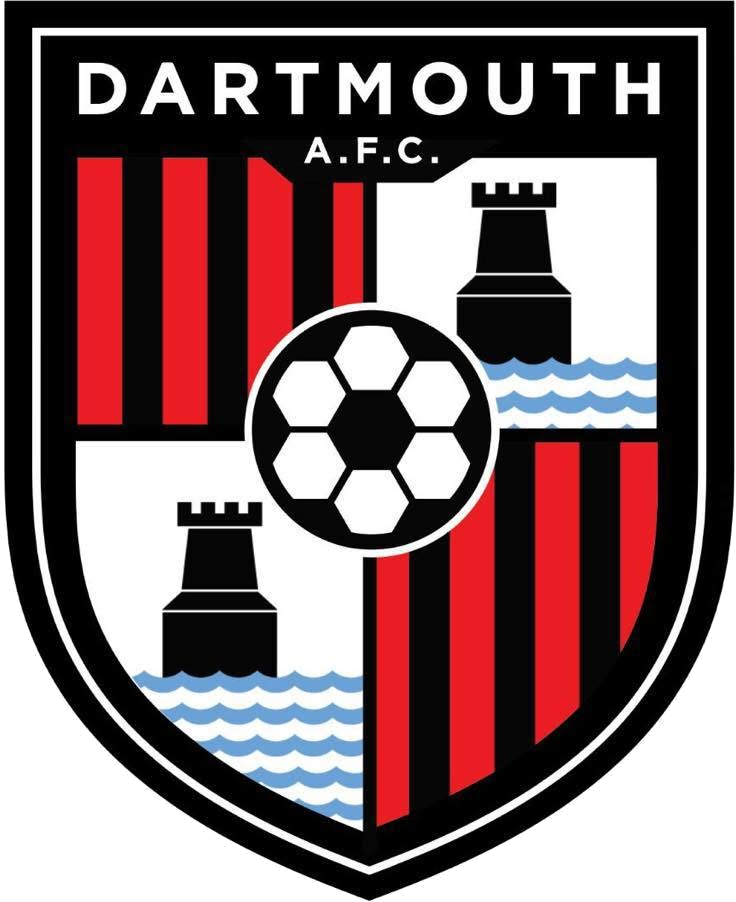
The badge was designed following the merger of Dartmouth United and Dartmouth Y.M.R.C. The two castles represented on the badge reflect Dartmouth Castle and Kingswear Castle, linking the football club to the local area.
The badge's black and red colours also represent the colours associated with the two clubs that came together to form Dartmouth AFC. The badge was later updated by player and designer Scott McRoy.
YOUTH FOOTBALL AND THE COMMUNITY
Dartmouth AFC is about more than its first team. Youth football has become an important part of the club, providing opportunities for young players in Dartmouth and the surrounding area.
The club has also supported the development of girls' football, including the Dartmouth AFC Swifts. Local businesses and organisations have provided sponsorship and financial support for youth teams, helping young players access kits, training equipment and football opportunities.
This community involvement is an important part of the club's identity. Dartmouth AFC has remained closely connected to the town it represents.
A PROUD FOOTBALL TRADITION
From its beginnings as Dartmouth United in 1908, through league championships, cup victories, the 1999 merger and periods of difficulty and rebuilding, Dartmouth AFC has continued to be an important part of football in Dartmouth.
The club's history includes Devon league championships, South Devon League titles, Devon Senior Cup victories and numerous other cup successes. It has also produced players who went on to play at higher levels. One notable former player is Ralph Birkett, who left Dartmouth to play for Torquay United and later represented England.
Today, Dartmouth AFC continues to represent the town at Longcross. More than a football team, the club is part of the sporting and community life of Dartmouth, with its history built by generations of players, coaches, volunteers, supporters and local families.
FROM DARTMOUTH UNITED TO THE MODERN DARTMOUTH AFC — THE DARTS' STORY IS ONE OF TRADITION, RESILIENCE AND COMMUNITY FOOTBALL.